Mold remediation vs water damage restoration: which does your home need
Mold remediation vs water damage restoration Fairfax: a plain-English guide to which service your home needs, how the two differ, and when to call each one.
If the damage is wet and recent, you need water damage restoration; if the damage is dry, musty, or visibly growing, you need mold remediation. That is the cleanest way to split the two, and it is the rule we use on every call in Fairfax. The rest of this post shows you how to apply it to your own home, what each service actually involves, and what each one costs in 2026.
Mold remediation vs water damage restoration Fairfax is really a question about timing and moisture. Water damage restoration removes water and dries the structure. Mold remediation removes mold and the conditions feeding it. Most Fairfax homes need the first one before the second one is even on the table.
The short answer: mold remediation vs water damage restoration in Fairfax
Mold remediation vs water damage restoration Fairfax comes down to one question: is the problem still wet, or has it already dried into a mold colony? Water damage restoration is the category of work that extracts standing water, dries structural materials, and restores what the water ruined. Mold remediation is the category of work that contains, removes, and cleans up mold growth and the moisture source behind it.
If you can still see water, hear a running pipe, or feel damp drywall, call for water damage restoration Fairfax VA first. If the water is gone but the wall smells like a basement and shows dark speckling, you are past restoration and into remediation.
Here is the practical version most homeowners want:
- Water damage restoration - active leak, burst pipe, flooded basement, storm intrusion, sewage backup. The clock starts the moment water touches the structure.
- Mold remediation - visible mold, musty odor, allergy symptoms that worsen indoors, or a moisture reading that stays high weeks after a leak was "fixed."
- Both - a slow leak that has been running behind a cabinet for months. We dry the structure and remove the mold in one project.
What water damage restoration actually does
Water damage restoration in Fairfax is a drying and rebuilding process, not a cleaning process. The goal is to get structural materials back to a normal moisture content before anything biological has a chance to take hold.
A typical job runs in this order: stop the source, extract standing water, remove saturated materials that cannot be saved, set drying equipment, monitor moisture daily, then repair and rebuild. On a standard Fairfax basement flood, we run commercial dehumidifiers and air movers for three to five days and check readings twice a day until the drywall, framing, and subfloor are back under 16 percent moisture content.
We handle the full range of sources. Burst pipe water damage repair in Fairfax is one of the most common calls we get between November and March, when supply lines in older homes freeze and split. Flooded basement cleanup Fairfax VA picks up in spring and summer, when the water table rises and sump pumps quit during storms. And sewage backup cleanup Fairfax VA is its own category entirely, because category 3 water carries pathogens and requires disinfection, not just drying.
What water damage restoration does not do is kill mold that has already colonized a surface. Drying stops new growth. It does not remove growth that is already there.
What mold remediation actually does
Mold remediation in Fairfax is a containment and removal process. The goal is to physically remove mold growth and spores, fix the moisture source that allowed it, and verify the air and surfaces are clean afterward.
A proper remediation job starts with containment. We seal the work area with plastic sheeting and run negative air pressure so spores do not travel into the rest of the house. Technicians wear respirators and protective suits. Contaminated drywall, insulation, and trim get bagged and removed. Remaining framing is HEPA-vacuumed and treated with an antimicrobial, then the cavity is dried and sealed.
Two numbers matter here. Mold needs moisture above roughly 60 percent relative humidity and a food source, which in a house means paper-faced drywall, wood framing, and dust. Take away the moisture and the colony stops spreading. That is why every remediation job ends with a moisture fix, not just a spray bottle.
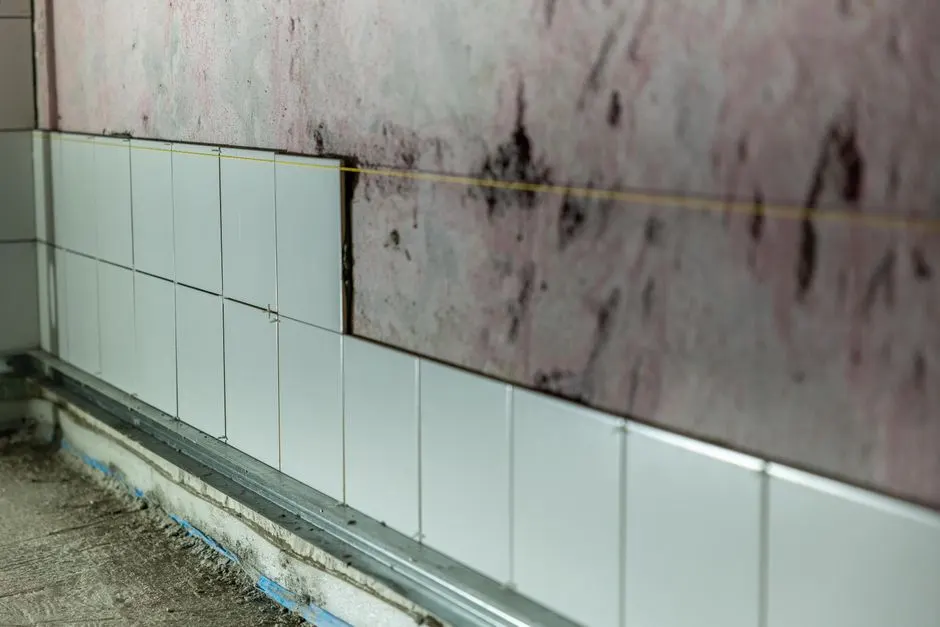
If you are seeing black or green speckling on drywall, window frames, or basement joists, that is the point to call for mold remediation Fairfax VA. We test, contain, remove, and verify - and we do not close a job until clearance readings are normal.
How to tell which one your Fairfax home needs
Fairfax homes give you clear signals, and they usually point to one service or the other. Here is how to read them.
Signs you need water damage restoration
- Standing water, wet carpet, or a squishy subfloor
- A ceiling stain that is still growing or dripping
- A water bill that jumped without a change in usage
- A musty smell that started within the last week
- Warped baseboards, bubbling paint, or a sagging ceiling
Signs you need mold remediation
- Visible mold on walls, ceilings, or grout lines
- A musty odor that persists after cleaning
- Allergy or asthma symptoms that ease when you leave the house
- Peeling paint or dark staining on basement framing
- A prior leak that was "fixed" but never dried
If you are unsure, the moisture meter decides. We check the affected materials and the surrounding cavity. A reading above 16 percent on wood framing or above 1 percent on a concrete slab means there is still active moisture and restoration comes first. A dry reading with visible growth means remediation.
We see the split constantly across water damage restoration Fairfax VA in Old Town Fairfax, where homes built in the 1940s and 1950s have plaster walls and small crawlspaces that hold moisture long after a leak stops. Those houses often need both services in the same visit.
When water damage turns into mold: the 24 to 48 hour window
Mold can begin growing on wet building materials within 24 to 48 hours, which is why the two services overlap so often in Fairfax. The window is short and it is not negotiable.
In practice, that means a supply line that drips behind a washing machine for a weekend can produce visible growth by the following Thursday. A basement that takes on two inches of water during a storm and gets mopped but not dried can show mold along the baseboards in under a week. We have pulled baseboard off walls in Fairfax homes where the homeowner never saw water at all - the leak was inside the wall and the mold was the first symptom.
This is why we tell people not to wait for the smell. If water touched the structure, get it dried. If it has been more than 48 hours and the area was not dried with commercial equipment, assume mold is starting and get it checked.
Which costs more in Fairfax: mold remediation or water damage restoration?
Mold remediation usually costs more than water damage restoration in Fairfax, because it involves containment, removal of contaminated materials, and clearance verification on top of drying. Typical 2026 pricing in this area runs $1,800 to $6,500 for mold remediation on a contained area, and $1,200 to $4,500 for water damage restoration on a comparable space.
The ranges are wide because the variables are wide. A small bathroom mold job contained to one wall may land near the low end. A finished basement with mold behind the drywall across 400 square feet will land near the top, and often above it once reconstruction is included.
Water damage restoration pricing depends on the water category, the square footage affected, and how long the water sat. Clean water from a supply line is the cheapest category. Sewage or storm water is the most expensive because of disinfection and disposal requirements. Drying equipment usually runs $300 to $700 per day for a typical residential setup, and most jobs need three to five days.
One thing worth knowing: insurance often treats these differently. Water damage from a sudden event is commonly covered. Mold that resulted from long-term neglect frequently is not. Document everything and call us before you start tearing anything out.
Common mistakes we see Fairfax homeowners make
The most expensive mistakes in Fairfax are the ones made in the first 24 hours, before anyone calls. Here are the ones we see most.
- Bleaching mold and calling it fixed. Bleach kills surface mold on non-porous materials. It does not reach roots in drywall or framing, and it does not fix the moisture feeding the colony.
- Running a household fan instead of a dehumidifier. A box fan moves air. It does not remove moisture. In a closed room, it can raise humidity and make things worse.
- Pulling out wet drywall without containment. Tearing out moldy drywall without plastic sheeting and negative air pressure spreads spores through the house.
- Assuming a fixed leak means the problem is solved. The leak is the cause. The moisture left behind is the problem. If it is not dried, mold follows.
- Waiting for the smell. By the time you smell mold, the colony is established. Moisture readings catch it earlier.
When to call a professional
Call a professional when water has touched structural materials, when mold covers more than about 10 square feet, or when you cannot find the moisture source. Those three conditions are past the DIY line.
Small surface mold on tile or glass is a cleaning job. Water in a basement that you can mop up in an hour and dry with a dehumidifier is a weekend job. But once drywall, insulation, or framing is wet, or once mold has moved into a cavity, you need commercial drying equipment and containment to do it right.
We handle both sides of this. If you are dealing with an active leak or flood, start with residential water damage restoration in Fairfax. If the water is gone and the growth is not, we move straight to remediation. Either way, we tell you which one you need before any work starts.
Frequently Asked Questions
What is the difference between mold remediation and water damage restoration in Fairfax?
Water damage restoration removes water and dries the structure. Mold remediation removes mold growth and the moisture source behind it. Restoration comes first when materials are still wet; remediation comes when growth is already present.
Do I need mold remediation or water damage restoration in Fairfax VA?
If water touched the structure within the last 48 hours, you need water damage restoration. If the area is dry but shows visible mold, a musty odor, or high moisture readings weeks after a leak, you need mold remediation.
Can water damage restoration remove mold in Fairfax homes?
No. Drying stops new mold growth but does not remove existing colonies. Restoration and remediation are separate processes, and homes with established growth need remediation after drying is complete.
Which is more expensive: mold remediation or water damage restoration in Fairfax?
Mold remediation typically costs more, running $1,800 to $6,500 in 2026 versus $1,200 to $4,500 for water damage restoration. Remediation adds containment, material removal, and clearance testing on top of drying.
How long does each service take?
Water damage restoration usually takes three to five days of drying plus repairs. Mold remediation on a contained area takes two to four days, with clearance testing afterward.
Get help with water damage restoration Fairfax VA in Fairfax
Whether you are looking at a wet floor or a wall that smells like a basement, we can tell you which service you need and get it handled. Call us at (725) 309-8505 and we will walk you through it.